


4 min read
Adult Tissue and Sex Diversity in SCI: Translational Drug Development
By: MD Biosciences on Jun 30, 2026 9:00:02 AM
Spinal cord injury presents one of the most challenging translational profiles in central nervous system drug development. The clinical need is substantial, patient willingness to participate in trials is high, and the regulatory framework is well established. Despite these favorable conditions, the translational record for SCI candidates remains among the weakest in CNS therapeutics. Compounds with strong preclinical efficacy frequently fail to demonstrate comparable effects in human trials. While a portion of this attrition reflects inherent constraints on adult CNS regeneration, a substantial component is attributable to long standing methodological choices in preclinical study design that have not been systematically reevaluated.
Two of these choices warrant specific attention, as both can be addressed within the design of a preclinical package. The first concerns the routine use of neonatal tissue for in vitro work. The second concerns the predominance of young male rodents in in vivo studies. Neither aligns with the patient populations these therapies are intended to treat, and both have measurable effects on the predictive value of preclinical data.
The Neonatal Tissue Problem
Primary neuron cultures in SCI research are most commonly derived from embryonic or perinatal tissue, typically before postnatal day 9. The rationale is operational. Neurons from young tissue grow vigorously, extend long neurites rapidly, and demonstrate high viability in culture. Phenotypically, however, these cells do not recapitulate adult spinal cord biology. Adult CNS is well documented as a non permissive environment for regeneration. Myelin associated inhibitors, glial scar components, and an adult tuned cytoskeletal program collectively suppress neurite outgrowth. A screening assay built on perinatal neurons therefore addresses a different question than the one relevant to adult SCI. The assay measures whether a candidate accelerates growth in an already permissive environment, not whether it can overcome the inhibitory milieu characteristic of adult spinal cord injury.
MD Biosciences operates in vitro neurodegeneration and regeneration assays in primary spinal cord neurons derived from adult (P60) tissue. The resulting phenotype is consistent with adult CNS biology. Neurite growth is slow, sensitive to inhibitory cues, and the assay window is correspondingly wider for detecting candidates that meaningfully override these constraints. The methodological tradeoff is real. Adult cultures are more demanding to maintain, exhibit greater variability across preparations, and require more careful tissue handling. The tradeoff is also defensible on translational grounds. A pro regenerative candidate that performs well in P0 cultures and fails in P60 cultures is providing predictive information about its likely performance in human SCI, and that signal warrants detection before a Phase II investment decision.
The Sex and Age Question
The in vivo component of SCI preclinical research has its own conventional design choices. Standard contusion models in rats use young male animals. The reasons are historical and operational. Young males are uniform, accessible, and the foundational SCI literature established its baseline data on this population. The cumulative result is that the field's library of published preclinical responses to neuroprotective and neuroregenerative candidates is overwhelmingly derived from young male data.
The clinical SCI population does not correspond to young males. SCI affects a wider age range, includes a substantial proportion of women, and increasingly involves patients with comorbidities. Each of these dimensions has measurable consequences for clinical outcome. In contusion induced SCI in rats, female animals recover more rapidly than males as measured by the Basso, Beattie, and Bresnahan locomotor scale and by transcranial motor evoked potential amplitude. The same injury and intervention can therefore yield different inferences depending on whether the experimental design includes females.
For a sponsor running a neuroprotection program, the implications are bidirectional. A candidate that performs well in young males may understate or overstate its likely effect in women. A candidate that fails to outperform vehicle in young males may retain value in older or female populations, and a male only design will not detect that signal. The conventional response is to defer these questions to confirmatory studies, but the cost of late stage discovery is substantial. Confirmatory studies that alter the conclusions on safety or efficacy are the most expensive mechanism for acquiring that information.
Components of a Better Resourced SCI Package
A well designed preclinical SCI program in current practice should incorporate adult tissue in in vitro screening, female and male animals in in vivo arms, and a structured assessment of whether comorbidities are relevant to the indication. The infrastructure to support all three is available.
For in vitro work, adult primary spinal cord neurons enable evaluation of pro regenerative candidates against the inhibitory phenotype present in human tissue. The endpoint, typically expressed as a neurodegeneration or regeneration index, captures neurite length, branching, and survival across the assay window. Candidates that produce meaningful effects on the index in adult cultures demonstrate higher likelihood of in vivo translation.
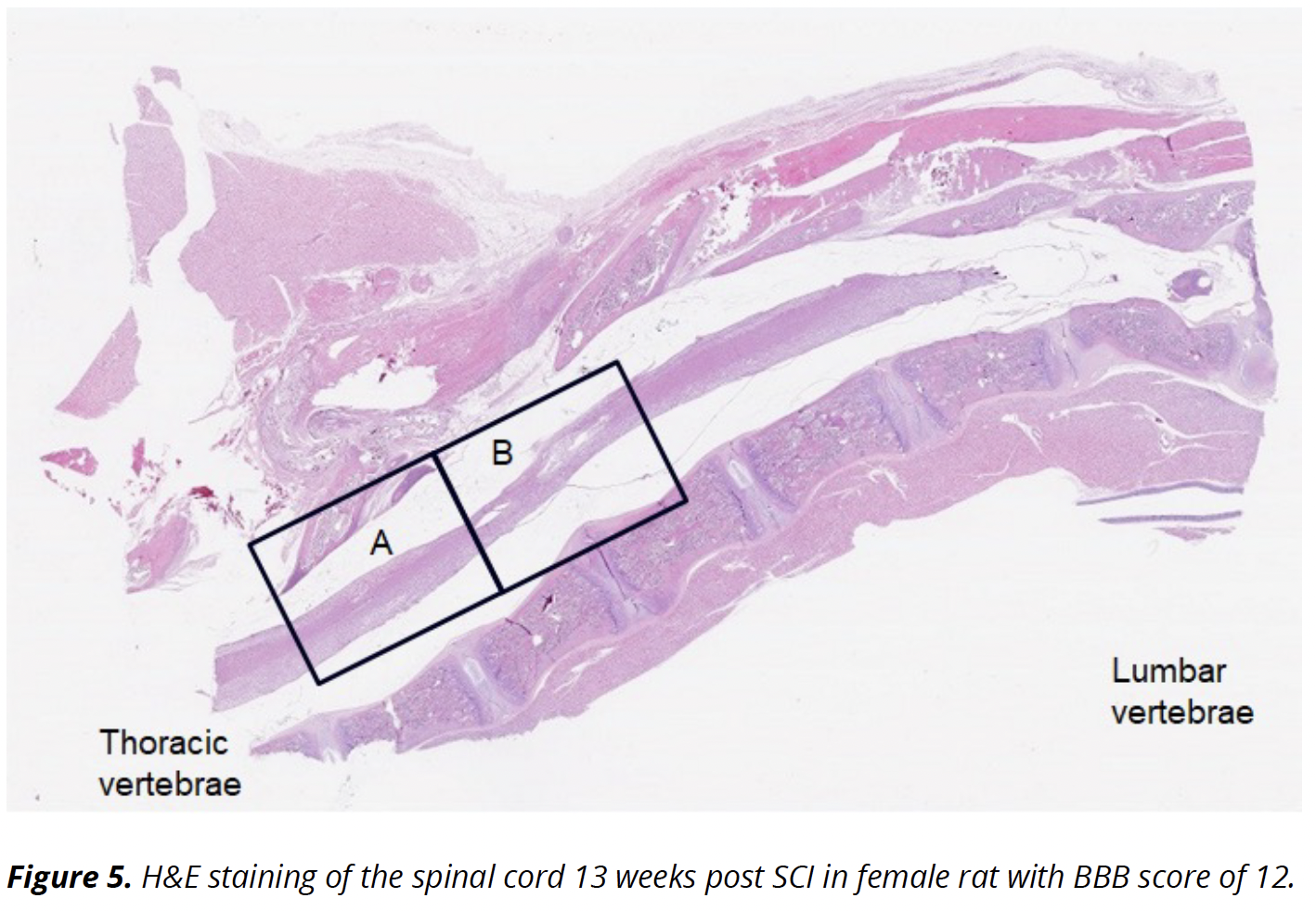
For in vivo work, contusion, cutting, and extraction models are available. The BBB locomotor scale provides a standardized functional readout, and electrophysiology adds tcMEP and tcSEP recordings, both capturing corticospinal and sensory pathway integrity. Histological assessment completes the readout panel, including Schwann cell markers (S100b), axonal integrity markers (NF200, Beta-III tubulin, GAP43), and quantitative measures of axon count and density across the injury site. When sex is incorporated as a design variable, differences in recovery trajectory become data rather than confounders, and treatment effects can be evaluated against a baseline reflecting clinical population diversity.
Summary
The SCI research community has refined in vivo and in vitro methodologies for decades, and the methodological toolkit is now sufficiently mature that the limiting factor in translational success is design choice rather than technical capability. A program that screens against permissive perinatal neurons and treats young males will frequently generate cleaner data than one using adult cultures and a mixed sex cohort. The cleaner data does not constitute the more informative answer. It is the answer to a different question.
For sponsors and academic groups designing SCI programs, MD Biosciences provides adult tissue in vitro assays, in vivo contusion and related models with diversity considerations integrated, and the electrophysiology and histology required to support translational readouts that map onto human disease.
For questions about study design, contact neuro@mdbiosciences.com.
Related Posts
Importance of Diversity in Preclinical Stroke Models
The Need for Diversity in Animal Models
The clinical population is diverse, including both sexes,...
Promoting Diversity for Translational Success
In preclinical efficacy studies, several factors are often overlooked, and it is important to...